
Trump administration will use "alternative legal authorities" to enforce tariffs on the countries, assuring that the tariff revenue will remain unchanged.

The Punjab and Haryana High Court is considering a plea regarding incarcerated MP Amritpal Singh's absence from Parliament, which has reached 59 sittings. The court has been informed that Singh can apply for condoning his absence, as continuous absence for 60 sittings could lead to his seat being declared vacant.

The Supreme Court on Friday refused to entertain a fresh plea challenging constitutional validity of the Waqf (Amendment) Act, 2025.

He will hold the office till February 9, 2027.
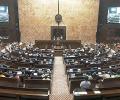
President Droupadi Murmu has given her assent to the Waqf (Amendment) Bill, 2025, which has sparked controversy and legal challenges. The Bill, passed by Parliament after heated debates, has been criticized by opposition parties as "anti-Muslim" and "unconstitutional". The government, however, maintains that the reform will benefit the Muslim community. Several petitions have been filed in the Supreme Court challenging the constitutional validity of the Bill, alleging discrimination against Muslims and undermining their religious autonomy. The Bill repeals the Mussalman Wakf Act, 1923, and introduces restrictions on Waqf properties and their management, which have raised concerns about the impact on the Muslim community.
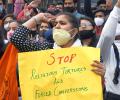
Justice Vinod Diwaker made the observation while rejecting a plea to cancel an FIR against four people accused under the Uttar Pradesh Prohibition of Unlawful Religious Conversion Act, 2021.
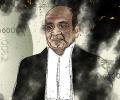
'If the parliamentary committee's report does not find substantiated charges, the process ends.'

Haryana State Vigilance and Anti-Corruption Bureau arrests 11 individuals, including bank employees and a government official, in connection with a fraud case involving IDFC First Bank and the illegal diversion of government funds.
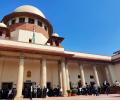
The Supreme Court on Monday agreed to consider listing for urgent hearing the petitions challenging the constitutional validity of the Waqf (Amendment) Act, 2025.
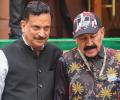
Rajiv Pratap Rudy secured another term as Secretary (Administration) of the Constitution Club of India, defeating Sanjeev Balyan in a closely watched election that saw participation from prominent political figures.

Customers will qualify for compensation even if they mistakenly share the OTP.
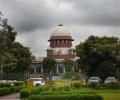
The Supreme Court has sought the Centre's response on a plea seeking the implementation of the 2023 Nari Shakti Vandan Act, which reserves one-third of seats for women in the Lok Sabha and state assemblies.

A fresh plea has been filed in the Supreme Court challenging the constitutional validity of the Waqf (Amendment) Act, 2025, claiming it was a "blatant intrusion" into the rights of a religious denomination to manage its own affairs in the matter of religion. The plea, filed by Samastha Kerala Jamiathul Ulema, argues that the amendments would distort the religious character of Waqfs and irreversibly damage the democratic process in their administration. Several other petitions have been filed in the apex court challenging the validity of the bill, including those by Congress MP Mohammad Jawed, AIMIM president Asaduddin Owaisi, and AAP MLA Amanatullah Khan.

A magisterial inquiry report reveals that the Goa nightclub where a deadly fire killed 25 people was built illegally on salt pan and operated without a valid trade license, indicating serious lapses and collusion at multiple official levels.

Customs duty cannot be levied on electricity supplied from a special economic zone (SEZ) to the domestic market, ruled the Supreme Court on Monday while upholding Adani Power's appeal against a 2019 judgment of the Gujarat high court. The 2019 judgment had denied relief to Adani Power from Customs duty on electricity supplied from its Mundra SEZ unit to the domestic tariff area (DTA).

'Refusal does not invite immediate legal penalty; it invites Constitutional unease.'

Underscoring the 'presumption of constitutionality in favour of law', the Supreme Court on Tuesday said petitioners challenging the waqf law needed a 'strong and glaring' case for interim relief.

Justice Surya Kant, who was elevated as a judge of the Supreme Court on May 24, 2019, would have a tenure of over 1.2 years as the CJI. He is due to retire on February 9, 2027.

Speaking to ANI on Wednesday, Razvi Bareilvi criticised Vijay for allegedly portraying Muslims negatively in his movies and for inviting individuals involved in gambling and liquor consumption to his iftar party.
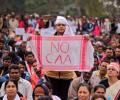
The Supreme Court on Wednesday said it will commence hearing on October 17 to examine the constitutional validity of Section 6A of the Citizenship Act relating to illegal immigrants in Assam.

Sebi Chairman Tuhin Kanta Pandey announced intensified surveillance and technology-driven enforcement to combat pre-investment scams targeting retail investors, who are increasingly being lured by fake trading apps and promises of high returns.
The Supreme Court has put on hold several key provisions of the Waqf (Amendment) Act, 2025, including the clause that only those practicing Islam for the last five years can dedicate a property as Waqf. The court also addressed the powers of collectors and non-Muslim participation in Waqf Boards.

In the Indo-Pacific's new era -- where perception shapes reality faster than treaties -- the real entrapment is not of China or the United States. It is the test Japan has set for itself -- and whether partners like India, acting as balancers rather than accelerants, can help ensure that the story ends in stability, points out Varun Arya.

Tamil Nadu's ruling DMK has filed a petition in the Supreme Court challenging the Election Commission's plan to implement the Special Intensive Revision of electoral rolls in the state.
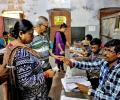
The Supreme Court has requested the Election Commission to respond to petitions challenging the Special Intensive Revision of electoral rolls in Tamil Nadu and West Bengal. The court has also asked the Madras and Calcutta High Courts to keep proceedings on similar petitions in abeyance.

The Delhi High Court has urged the family of the late industrialist Sunjay Kapur, including his mother, wife, and other relatives, to resolve their estate dispute peacefully, emphasizing the importance of family relations and preventing financial wealth from becoming a source of conflict.
The Supreme Court of India will likely hear a batch of petitions challenging the constitutional validity of the Waqf (Amendment) Act, 2025 on April 15. The Act, which came into force on April 8, has been met with widespread criticism from various stakeholders, including politicians, the All India Muslim Personal Law Board (AIMPLB), and Jamiat Ulama-i-Hind. They argue that the law is discriminatory and violates the fundamental rights guaranteed under Articles 25 and 26 of the Constitution. The petitions allege that the amendments give the government more control over the administration of Waqf, effectively sidelining the Muslim minority from managing their own religious endowments.

Nitin Nabin, a five-time Bihar MLA, has been elected unopposed as the BJP national president, becoming the youngest person to hold the position. His appointment signals a generational shift in the party's leadership as it prepares for key state elections.

Uttar Pradesh authorities have registered 74 cases and arrested 75 people in connection with the illegal storage and sale of codeine-based cough syrup. A minister alleges links to the Samajwadi Party and an SIT is investigating.

The Supreme Court has stayed a recent University Grants Commission (UGC) regulation following petitions arguing that the Commission's definition of caste-based discrimination was too narrow, excluding certain categories from institutional protection.

Phase-wise counting of votes in Mumbai civic polls, instead of simultaneously across all 227 electoral wards as done in 2017, could delay the declaration of results when the enumeration process begins on Friday morning, civic officials said on Thursday.

The Supreme Court on Thursday upheld the constitutional validity of Section 6A of the Citizenship Act related to the grant of Indian citizenship to illegal immigrants in Assam by a majority verdict of 4:1.

The Supreme Court is examining the validity of the Election Commission's decision to conduct special intensive revisions of electoral rolls in several states, focusing on concerns about democratic participation and the burden on ordinary voters.

Referring to the enactment of the Chhattisgarh Auxiliary Armed Police Force Act, 2011 which created a trained force to aid and assist the security forces in maintaining law and order in the state, the bench said in its view it cannot be said to be an act of contempt of the order of 2011 passed by this court.

Election Commission's Special Intensive Revision (SIR) of voters' list commenced in nine states and three Union territories on Tuesday, amid objections from several parties with Chief Minister Mamata Banerjee leading the anti-SIR offensive in West Bengal with a rally in Kolkata and alleging 'silent, invisible rigging' through the exercise.

Justice Surya Kant is set to become the 53rd Chief Justice of India, bringing extensive experience and a record of significant verdicts on key issues.

The matter would be heard by Chief Justice B R Gavai and Justice Augustine George Masih.

The Supreme Court on Tuesday referred to a Constitution bench of at least five judges a batch of pleas challenging the constitutional validity of the colonial-era provision of sedition under the Indian Penal Code (IPC).

The Bharatiya Antariksh Station represents the next phase of India's human spaceflight ambitions, enabling long-duration presence in space, advanced microgravity research and technology development, and supporting future human exploration missions.

Bangladesh's top legal official has proposed to remove the words 'secularism' and 'socialism' from the Constitution apart from a provision prescribing capital punishment for regime change through extra-constitutional means.
